Materials Guide
Cabinet materials that hold up to Florida humidity
Why plywood outperforms particleboard and MDF in a Gulf Coast home, what the different moisture-resistant grades actually mean, and which material fits which room.
The short answer
Plywood, especially marine or BWP-grade, holds up to Florida humidity far better than particleboard or standard MDF because of how it's built, not just how it's treated. For garages specifically, powder-coated steel, aluminum, or PVC generally outperform wood entirely.
Why plywood wins: it’s about construction, not treatment
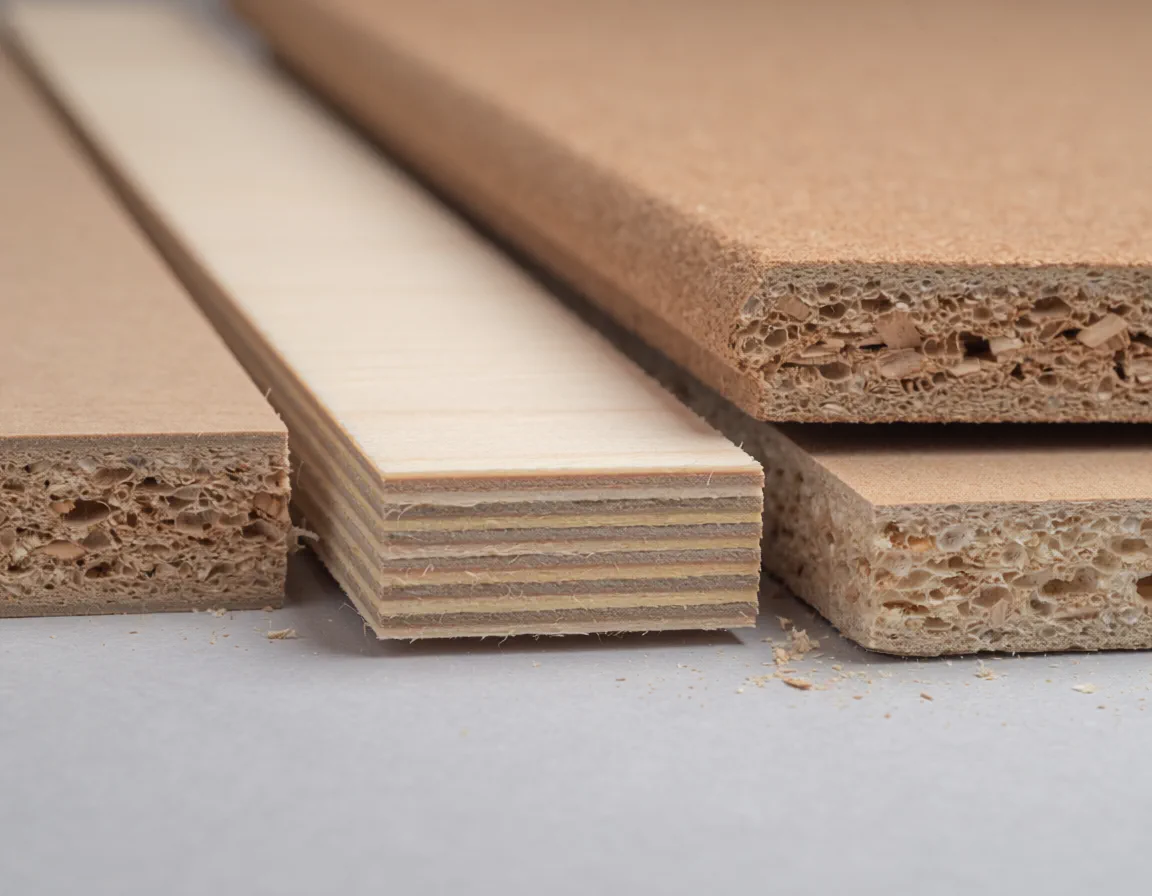
Most cabinet material advice treats “moisture-resistant” as something applied to a material rather than something built into it, and that’s backwards for understanding why plywood consistently outperforms particleboard and MDF. Plywood is built from thin layers of wood veneer, glued together with the grain direction alternating in each layer. That cross-grain structure is what resists warping and swelling, the layers constrain each other’s movement as humidity changes. Particleboard and standard MDF don’t have that structure. Particleboard is compressed wood chips and resin with no grain orientation at all; MDF is finer wood fibers pressed the same way. Both absorb water more or less uniformly through the material, and once particleboard swells, it typically doesn’t return to its original shape, even after it dries out.
The practical difference shows up fast. In side-by-side moisture testing, particleboard shows visible water absorption, darkening and slight swelling, within 5 to 10 minutes of contact. Plywood, especially properly sealed plywood, resists that same exposure far longer, with water beading on the surface rather than soaking in immediately.
A failure mode most homeowners don’t expect: hardware, not the box
Material choice affects more than whether a cabinet box eventually swells. Plywood holds screws well in every direction, including at cut edges. Particleboard and MDF hold screws considerably more poorly at their edges specifically, which matters because that’s exactly where hinges and drawer slides attach to the cabinet. A common early sign of the wrong material choice isn’t a swollen door, it’s a door that starts sagging or a drawer slide that works loose well before the cabinet box shows any visible humidity damage. If you’ve ever had a kitchen or bathroom cabinet door go crooked within a few years, loose hardware in a weak substrate is a more likely explanation than most homeowners assume.
Grades worth knowing
Not all plywood or MDF is the same. Marine-grade or BWP (boiling water proof) plywood uses waterproof adhesives and represents the highest moisture resistance available in a wood-based product, worth the upgrade for bathroom vanities, laundry cabinetry, or anything near a lanai-facing window or sliding door where humidity exposure is highest. Moisture-resistant MDF, sometimes labeled MR or HMR, is a genuine step up from standard MDF and particleboard, though it still doesn’t match plywood’s performance, it’s a reasonable choice for painted doors and detail trim where the budget doesn’t stretch to full plywood construction throughout.
Hardware has its own grading question, covered in more depth on our Siesta Key page: standard 304 stainless holds up fine inland, but within reach of direct salt air, 316 marine-grade stainless resists the corrosion that 304 doesn’t.
Why the room matters as much as the material
The same material performs differently depending on where it’s installed. Kitchens and bathrooms see the highest humidity exposure in a typical home, ambient Gulf Coast humidity compounded by steam from cooking, dishwashers, and showers, which is why plywood over particleboard matters most in those two rooms specifically. Closets are a different problem: low airflow rather than direct water exposure, which is exactly the condition that lets moisture sit rather than dissipate, a musty closet is usually a materials-and-airflow issue rather than a cleaning one. Garages are different again, an uncontrolled-climate space with higher heat and humidity than the rest of the house, plus real termite and pest pressure that indoor rooms don’t face. That’s the one place on this site where we don’t default to wood at all, powder-coated steel, aluminum, and PVC hold up to that specific combination of conditions in a way that even well-sealed plywood generally can’t match.
Finish matters too, not instead of material
Core material and finish solve different problems. The core determines what happens once moisture reaches it; the finish determines how much moisture reaches it in the first place. A properly sealed, multi-coat finish on all interior and exterior cabinet surfaces, not just the visible faces, meaningfully slows moisture penetration regardless of which core material is underneath. The two decisions work together: a good core with a poor finish, or a good finish over a poor core, both underperform a cabinet where both choices were made correctly from the start.
At a glance
Material comparison
How the common cabinet materials actually perform in Gulf Coast humidity.
- Plywood (standard)
- Cross-grain veneer layers resist warping and swelling far better than particleboard or MDF. The standard choice for cabinet boxes throughout this site's kitchen, vanity, and closet work.
- Marine or BWP-grade plywood
- Built with waterproof adhesives for the highest moisture resistance available in a wood product. Worth the upgrade for bathroom vanities, laundry areas, or any cabinetry near a lanai-facing window or sliding door.
- Moisture-resistant MDF (MR/HMR)
- Denser and more uniform than particleboard, and noticeably better than standard MDF, but still not as moisture-resistant as plywood. A reasonable middle ground for painted doors and trim where budget matters more than maximum durability.
- Standard particleboard
- The material to avoid in any humidity-exposed cabinetry. Absorbs water fastest of any common cabinet material and swells irreversibly, visible water absorption within 5 to 10 minutes of contact in testing.
- PVC and high-pressure laminate
- Fully moisture-proof rather than moisture-resistant. The standard choice for garage cabinetry and an option for bathroom vanities where maximum water resistance matters more than a natural wood look.
- Powder-coated steel and aluminum
- Not wood at all, and that's the point. The default recommendation for garage cabinetry, where heat, humidity, and Florida's pest pressure rule out even good-quality sealed plywood as the first choice.
Common questions
- Why is plywood better than particleboard or MDF in humidity, specifically?
- It comes down to construction, not just treatment. Plywood is built from thin layers of wood veneer glued with the grain alternating in each layer, which resists warping and swelling. Particleboard and standard MDF are made from wood chips or fibers pressed together with no grain structure, so they absorb water quickly and swell, often irreversibly, once soaked.
- Does moisture-resistant MDF solve the problem?
- It helps, but it's a middle ground, not a plywood replacement. MR or HMR-grade MDF is denser and holds up better than standard MDF or particleboard, but it still doesn't match plywood's moisture resistance. It's a reasonable choice for painted doors and trim where budget matters more than maximum durability.
- Why does material choice affect how long hinges and drawer slides last?
- Plywood holds screws well in all directions, including at the edges, where hinges and drawer slides actually attach. Particleboard and MDF hold screws far more poorly at the edges, which is a common reason cabinet doors start sagging or drawer slides work loose well before the cabinet box itself shows visible damage.
- Is particleboard ever an acceptable choice in a Florida home?
- Only in fully climate-controlled, low-humidity spaces with no water exposure risk, and even there, plywood or moisture-resistant MDF is generally worth the upgrade. We don't use standard particleboard in kitchens, bathrooms, closets, or anywhere with real humidity exposure.
- Why don't you recommend wood for garage cabinets?
- Garages are uncontrolled-climate spaces with higher heat and humidity than the rest of the house, plus Florida-specific pest pressure from termites and other wood-destroying insects. Powder-coated steel, aluminum, and PVC resist both moisture and pests in a way that even well-sealed plywood can't fully match in that environment. See our garage cabinets page for the full explanation.
- Does the finish matter as much as the core material?
- Both matter, but they solve different problems. The core material determines how the cabinet responds to moisture that reaches it; the finish determines how much moisture reaches the core in the first place. A properly sealed, multi-coat finish on a plywood box outperforms an unsealed or poorly finished box of the same material.